

Christmas light installation safety isn't a checklist you skim before the season — it's the difference between a profitable December and a phone call no contractor ever wants to make. I've worked Christmas light installs for years while running a 43,000+ member installer community, and as a firefighter, EMT, and Hazmat responder, I've also seen the other side of what happens when residential ladder work goes wrong. The same gravity, brittle plastic, and 120-volt circuits that bite homeowners every December don't care that you're a professional. The good news: almost every serious incident on a Christmas light job comes from a small list of avoidable mistakes, and once your crew knows what they are, you can run a full season without a single near-miss.
Why Christmas Light Safety Is Different From Other Trades
Most trades work in controlled environments. A roofer is on the same roof for two days with the same crew and the same forecast. An electrician is in one panel for an afternoon. Christmas light installers do something none of those trades do: we hit four to eight different houses a day, in late-fall weather, with crews running on coffee and short daylight, dragging ladders onto roofs nobody has inspected. Then we do it again the next day, on a different roof, in a different city. That repetition is where complacency creeps in — and complacency is what hurts people.
The other variable is the customer. You're working over the homeowner's gutters, plants, vehicles, and kids. A dropped tool that's a non-event on a commercial site is a windshield or a kid on a Big Wheel at a residential job. Safety on Christmas light installs has to cover the crew and everything within drop range.
The good news is that the failure modes are well-known. Falls from ladders and roofs are the #1 cause of serious injury on this work, by a wide margin. Electrical incidents are second — almost always from old extension cords, taped connections trapping water, or homeowner GFCI outlets that should have been replaced years ago. Once you know that, you can build a process around it. For a deeper look at how to bid jobs that actually leave time for safety (instead of forcing you to rush), see our contractor's bidding breakdown.
The Christmas Light Installer's Five Biggest Risks
Before getting into the specific gear and procedures, understand what you're actually defending against. Almost every injury on this job traces back to one of five categories. Build your safety program around these five and you'll avoid the vast majority of incidents.
| Risk | How It Happens | Pro Mitigation |
|---|---|---|
| Ladder fall | Overreaching, ladder kicked out at the base, missing standoff against gutters | Ladder standoff mandatory on every ladder, 4:1 angle, three points of contact, nobody on a ladder alone over 12 ft |
| Roof slip | Wet shingles, frost, moss, steep pitch, working too close to the edge | No-go on wet/icy/windy roofs; soft-sole boots only; harness and anchor on anything over 6/12 pitch |
| Electrical fault | Bad GFCI, taped connections, brittle SPT wire, wrong amperage on a run | Portable GFCI on every cord, no tape on connections, LED-only loads, sockets oriented downward |
| Fatigue / rushing | Too many jobs in a day, late-day pushes to "knock out one more" | Realistic daily route, hard stop at sundown, pre-bulb and pre-clip in the shop to compress field time |
| Dropped object | Tools or strands falling off a roof onto cars, plants, or people | Tools tethered to the vest, designated drop zones, customer vehicles moved before work starts |
Notice that none of these mitigations are exotic. They're all process. The contractors who run safe seasons aren't the ones with the most equipment — they're the ones who built the process and refused to break it on a Friday at 4:30 p.m.
Ladder Safety: The Single Highest-Leverage Topic
Ladder falls account for the majority of serious injuries on residential exterior work. The OSHA data has been consistent for decades: people fall because the ladder's base moves, because they overreach sideways, or because the top of the ladder slides off whatever it's leaning on. All three are preventable.
- Use a ladder standoff on every extension ladder, every time. A standoff (also called a stabilizer) holds the top of the ladder off the gutter, distributes load to the wall, and stops the side-to-side wobble that throws people off. There's no ladder on a Christmas light job that should be touching gutters directly.
- Set the angle right. One foot of base distance for every four feet of working height. Ladders set steeper than that go over backwards; ladders set shallower than that slide out at the base.
- Three points of contact, always. Two hands and a foot, or two feet and a hand. The moment you reach sideways with a tool, you're down to two points and you're gambling.
- Don't climb past the third rung from the top. Above that, your center of gravity goes over the ladder and there's nothing to hold onto. If the bulb is too high, get a longer ladder.
- Foot the ladder on anything sketchy. If you're on grass, mulch, gravel, or a slope, a second installer needs hands on the bottom rails until the climber is off.
One myth worth killing: aluminum ladders are fine for Christmas light work. The "fiberglass only" rule comes from electrical trades that work hot circuits — that's not us. Aluminum is lighter, easier on your back at the end of an eight-house day, and just as strong. We use aluminum across our crews. The electrical risk on Christmas light installs is in the cord and the connection, not in the ladder.
For the full equipment list including the standoffs, vests, and poles we actually run, see our contractor's equipment list.
Roof Work: When to Climb and When to Walk Away
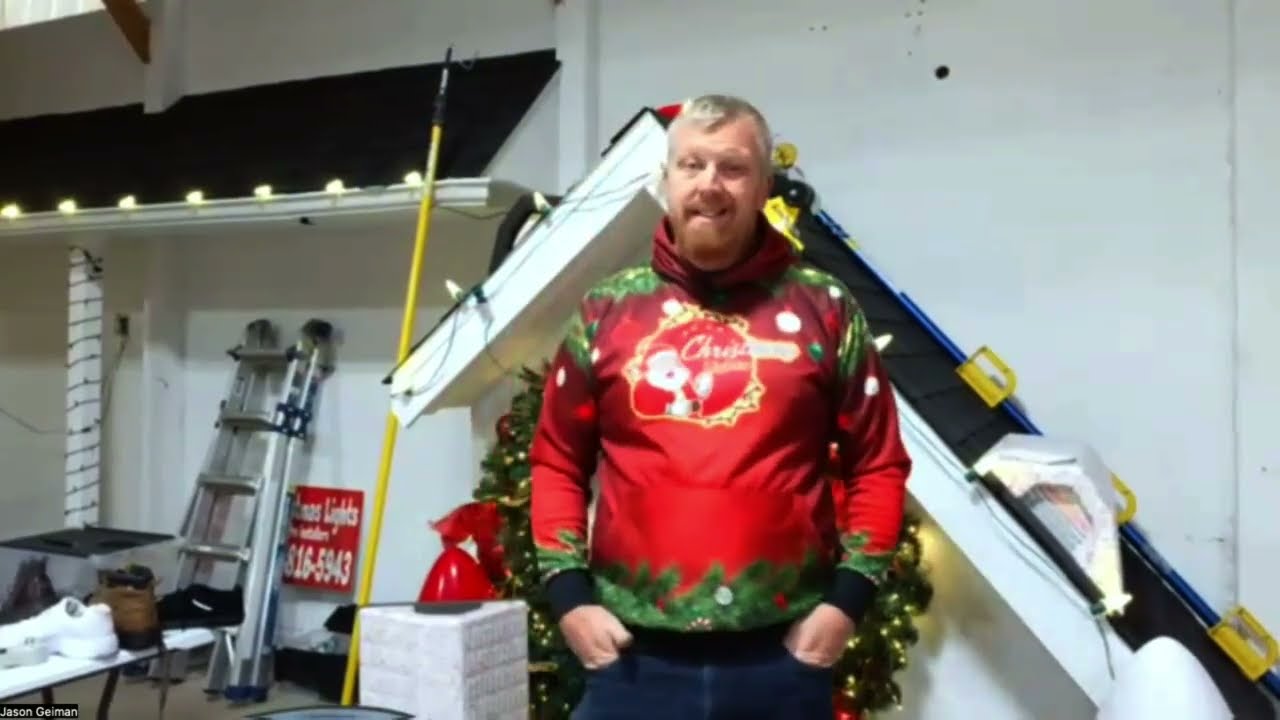
The single most-broken safety rule on Christmas light jobs is "no work on a wet roof." Crews break it because the schedule is tight, the customer is watching, and the install only takes 20 minutes. None of those reasons matter when someone slides off a wet shingle into a driveway.
Hard rules for roof work on every ChristmasLightsHQ-style operation:
- No wet, frosted, icy, or moss-covered roofs. Reschedule. Customers understand. Hospitals are expensive.
- No roof work in winds over 25 mph. Gusts over a roofline are stronger than the forecast at ground level.
- Soft-sole boots only. Hard work boots are great on a job site; on asphalt shingles, they slide. We run rubber-soled approach shoes.
- Harness and anchor on anything over a 6/12 pitch. Below 6/12 you can usually work safely without one if the surface is dry. Above that, anchor in.
- Stay off the valleys. No lights run through valleys, period. Valleys collect water, debris, and ice — they're the worst place for both your wire and your boots. Visible wire jumping a valley is normal and acceptable.
- Eyes on the edge. A spotter at ground level watches the climber the entire time anyone is within four feet of the eave.
"Roof slip" sounds dramatic, but the typical version is mundane: an installer steps onto a patch of frost they didn't see, slides three feet, and stops at the gutter. The gutter wasn't designed to stop a person and it doesn't. That's why the rule is "no wet roofs," not "be careful on wet roofs." For the actual install techniques once the roof is safe to work, our roofline installation guide walks the full process.
Electrical Safety: The Quiet Killer on Christmas Light Jobs
Electrical incidents on Christmas light jobs almost never happen on the roof. They happen at the outlet, at the connection, and inside taped-up junctions where water has been sitting for two weeks. As a firefighter, I've been on calls for residential exterior fires that started exactly this way — a lit, water-logged connection in a shrub at 2 a.m.
The rules that prevent this are not complicated:
- LED only. If you're still running incandescent, stop. The amperage difference isn't a preference — it's a fire margin. C9 LEDs draw less than 1 watt per bulb (about 0.9W); 100 bulbs is roughly 90W, well under one amp. Long runs of 500–1,000+ feet on SPT-1 are routine on LEDs. I've personally run 1,000 ft pulling 5 amps without an issue.
- Never tape connections. Tape traps water against the conductor and accelerates corrosion. It also makes GFCI nuisance trips ten times worse. Leave connections open, oriented down, and let them drain.
- Orient sockets downward. Every socket on every strand points at the ground. This is the single biggest reason pro installs don't trip GFCIs after the first rain.
- One portable GFCI protector on the truck. You only need one — that's it. Use it whenever you're not 100% sure the homeowner's outdoor outlet has a working GFCI. Never test the homeowner's GFCI button — if you trip it and it doesn't reset, that's now your problem and your liability. For more on this, our GFCI requirements guide covers the code rules in detail.
- SPT-1 18-gauge is your default. SPT-1 and SPT-2 are typically both 18-gauge, both rated for the same amperage (10A under 50 ft, 7A on longer runs). SPT-1 is correct for nearly all seasonal work. Save SPT-2 for permanent installs and extreme cold environments. Compare both in our SPT-1 vs SPT-2 article.
- Make your own extension cords. Cut SPT-1 zip wire to length with vampire (zip) plugs. No pre-made cords with brittle insulation, no household orange extensions on a roof.
Definition — Vampire plug: A "vampire plug" (also called a zip plug) is a slide-on or screw-on connector that bites into SPT zip wire and creates a sealed plug or socket without stripping insulation. It's the building block of every custom extension cord on a pro Christmas light truck.
One more thing on GFCIs: splitting a long run into two shorter runs does not fix nuisance tripping. The cause is moisture in connections, not load. Fix the connections.
Tools That Keep You Safe (and the Ones You Don't Need)
The contractor tool market is full of "must-have" gadgets. The truth is that a safe, fast Christmas light truck runs lean. Here's what we actually use, and what we skip.
Carry these: ladder standoff on every extension ladder, fisherman's vest (not a tool belt — vests keep weight high and centered), Mr. Reach pole ($40–$50) for installing strands without climbing, a water-fed pole for high windows ($500–$1,000), precision cutters and side cutters, a kilowatt meter or a multimeter with a clamp for verifying current draw, soft-sole approach shoes, climbing helmet for anyone in a drop zone, harness with anchors for steep roofs, and one portable GFCI protector.
Skip these: wire strippers (you don't need them — vampire plugs bite through insulation), pliers, zip ties for connections (label only), laser distance measure (we measure with the truck), electrical tape on connections, velcro, GFCI testers (the portable adapter is the test), light test bulbs, and circuit tracers.
The "less gear" approach isn't minimalism — it's risk reduction. Every tool you carry up a ladder is something you can drop, snag, or lean toward when you should be focused on three points of contact. Our full pro tool list lives at christmaslights.io/tools, and we go deeper on it in our contractor equipment list.
The Pre-Bulb, Pre-Clip Process: Safety Through Shop Time
The fastest way to make a job safer is to spend less time on the ladder. The way pros do that is by doing all the assembly work in the shop, before the truck rolls. Strands arrive at the house already bulbed and already clipped — ready to drape onto the roof and cut to length on-site.
- Build one continuous run of SPT-1 in the shop. We don't pre-cut to a specific house length — we feed it into a big garbage can or tote and cut to size when we get to the job. That way one prepped run can serve any house on the route.
- Install vampire plugs and sockets at the marked spacing — 12" or 15" only — as you feed the wire down the run.
- Push Tuff Clips (the enclosed pro clip) onto every socket as you go. Tuff Clips, not all-in-one clips. Specialty roofs use Tuff Mag, Tuff Tile, Tuff Shingle, Tuff Tab, Wedge Clip, or Flex Clip as needed.
- Screw in C9 LED bulbs (plastic Tuff bulbs, 7-year warranty) before the strand leaves the shop.
- Coil into the can/tote with the circle-wrapping method — never figure-eight. Circle wraps unspool clean and don't kink the wire.
- On the job site, pull from the can, cut to length for that section of the home, and cap the end. No zip ties or tape on connections at this point.
Definition — Tuff Clip: An enclosed (not all-in-one) plastic clip designed to grip an SPT socket and lock it onto a shingle, gutter lip, or trim board. It's the workhorse of pro roofline installs and the reason crews can move from house to house without spending an hour clipping at each one.
Pre-bulbing also means your installer is up the ladder for minutes, not an hour. That alone removes the largest safety variable on the entire job. For a closer look at the on-site install once strands are pre-built, see our professional packages guide, which covers what's in a standard 100-ft package and how it's prepped.
Customer-Side Hazards: What to Watch Before You Climb
Customers don't always know what's about to happen on their property. A two-minute walkaround before the ladder comes off the truck protects them and you.
- Move customer vehicles out of the drop zone. Always. Even a falling clip can crack a windshield. And anyone working on the ground inside that drop zone should wear a climbing helmet — it's not overkill, it's smart. A clip or bulb falling from a two-story roof has more than enough energy to put someone down.
- Check for in-ground sprinkler heads where ladder feet will land. A ladder foot crushes a head every season — and the homeowner blames the installer, not the manufacturer.
- Verify the outdoor outlet has a working GFCI. If unsure, use your portable GFCI protector. Do not press the homeowner's reset button.
- Look up for power lines. Aluminum ladders + overhead service drops = a fatal day. Stay 10 feet clear, minimum.
- Note pets, kids, and the front door. If a kid can wander into the drop zone, route the customer through a different door before you start.
- Inspect the gutter and roof edge. If you're seeing rotten fascia or loose gutters, document it with a photo and tell the customer before you put a ladder against it.
That walkaround is also a sales tool. Customers who watch a contractor inspect their property before climbing tend to refer more business — it's the kind of professionalism that drives the reviews that drive the next season's pipeline.
Takedown Safety: The Forgotten Half of the Season
Most contractors think of safety as an October–December problem. Takedown — January through February — is when guards drop. The lights are coming down, the season is over, and there's an internal rush to be done with it. That's when the slip happens.
The same rules apply: no wet roofs, ladder standoff every time, soft-sole boots, harness on steep pitches. Don't remove bulbs or clips at takedown — everything stays assembled, gets coiled with the circle method, and goes back into the labeled tote. Standalone takedown for jobs you didn't install runs $75–$200; for your own customers, it's included in the $8–$12/ft red-carpet pricing. For the full takedown SOP, our takedown pricing and process article covers it end-to-end.
One last takedown safety note: your crew is tired by January. The season has been long, the days have been short, and the December rush has worn everyone down. That fatigue is the #1 reason takedown is when injuries cluster. Plan for it. Shorter days, two-person crews on every truck, and a hard rule that nobody climbs after dark in winter. Your profit margins won't survive a workers' comp claim — neither will your business.
Related Guides
Safety doesn't live in a vacuum — it sits on top of solid pricing, the right equipment, and clean install technique. These related guides go deeper on the topics this article touches:
- How to Hang Christmas Lights on a Roof Like a Pro
- Christmas Light Installation Equipment List
- GFCI Requirements for Christmas Light Installations
- SPT-1 vs SPT-2 Wire: Which Should Contractors Use
- Christmas Light Installation Insurance Coverage
- Voltage Drop in Christmas Lights
And if you're stocking the truck right now, our C9 LED collection, pro clip collection, and professional Christmas light kits are built around the same standards used in this guide. The Christmas light calculator helps size jobs accurately so you're not adding strand-on-strand at the truck.
Frequently Asked Questions
What is the most common Christmas light installation injury?
Ladder falls are by far the most common serious injury, followed by roof slips. The vast majority happen because the ladder's base shifts, the installer overreaches sideways, or the roof surface is wet, frosted, or moss-covered. Using a ladder standoff on every climb, maintaining three points of contact, and refusing to work on wet roofs eliminates the bulk of these incidents.
Are aluminum ladders safe for Christmas light work?
Yes. The "fiberglass only" rule comes from electrical trades that work hot circuits, and it doesn't apply to Christmas light installs. Aluminum ladders are lighter, easier on installers' backs over an eight-house day, and just as strong structurally. The electrical risk on this work is in the cord and the connection, not in the ladder itself — keep the ladder 10+ feet away from overhead service drops and you're fine.
How do I prevent GFCIs from tripping on Christmas light jobs?
Keep all sockets oriented downward, never tape any connection, and let connections drain. Use SPT-1 18-gauge wire with LED bulbs only — C9 LEDs draw under 1 watt each, so even 1,000-foot runs stay well under the GFCI threshold. Carry one portable GFCI protector on the truck and never test the homeowner's GFCI by pressing the reset button. Splitting a run into two shorter runs does not fix tripping — moisture in connections does.
Do I need a harness on every Christmas light roof?
Not on every roof, but on any pitch over 6/12 yes. Below 6/12, with dry shingles and soft-sole boots, you can usually work safely without one. Above 6/12, on wet conditions, or in winds over 25 mph, harness up to a permanent anchor. The rule of thumb: if you'd hesitate to walk that pitch without lights in your hands, you need a harness.
What should I do if I find a damaged GFCI outlet on a customer's home?
Document it with a photo, tell the homeowner immediately, and use your portable GFCI protector to power your strands. Never test or attempt to repair the homeowner's GFCI — that's an electrician's job and a liability you don't want. Replacing a residential GFCI requires a licensed electrician under most state codes, and it's outside the scope of a Christmas light contract. One portable GFCI protector on the truck is all you need to handle this scenario.
Christmas light installation is one of the more profitable seasonal trades available — but only if you finish every season with the same crew you started with. Build the safety process before the rush, and December takes care of itself.